Give glasses and small bedtime objects a repeatable location
Glasses, a book and a small personal light are easy to misplace when bedding fills the tent floor. Establish a bedtime location before the first night. The method relies on a few identifiable objects and the shelter's supported storage features rather than extra hanging weight or improvised attachments.
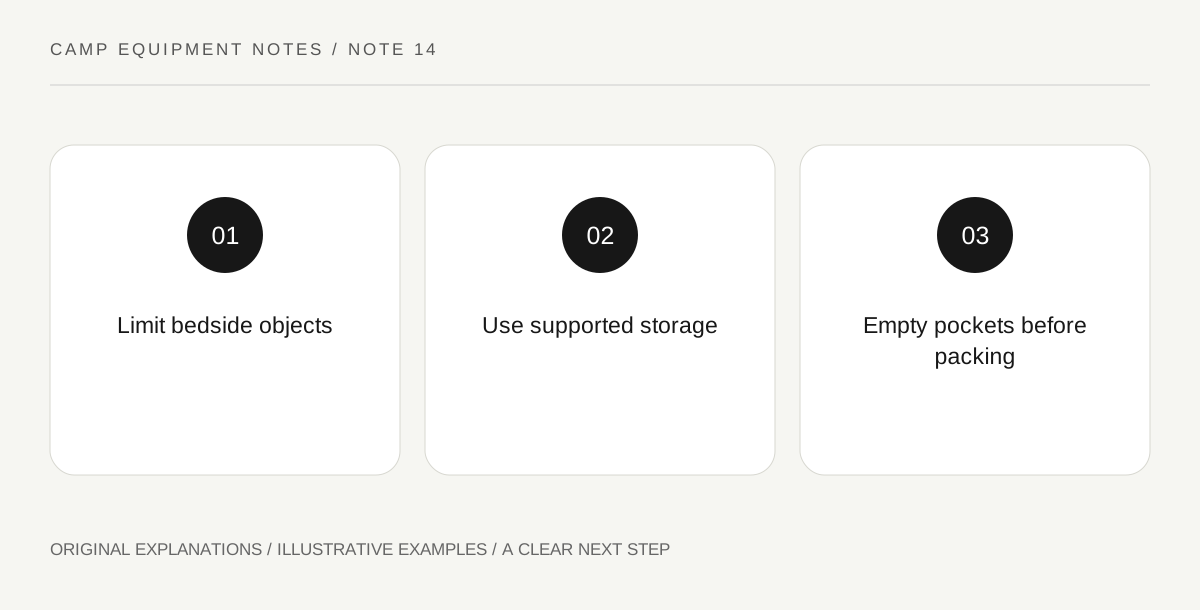
Original explanatory diagram. Read the full method and limitations below.
Choose the truly necessary objects
List what must be reachable from the sleeping position. Keep the list short: perhaps glasses in their case, a personal light and essential personal items managed according to their own instructions. Food and scented belongings need the campsite's required storage location. A bedtime pocket is not a way around those rules. Reducing the objects in reach makes it easier to distinguish an essential item from the general clutter that accumulates during unpacking.
Use the supported storage location
Inspect the tent's included pockets and permitted storage attachments. Check reach from the pad without pulling on the wall or leaning across another sleeper. Keep within the maker's load guidance and avoid attaching heavy objects overhead. A visible pocket may be unsuitable if a door movement empties it or if the item presses uncomfortably into the sleeping space. Test the actual arrangement rather than judging only by where the pocket appears in a diagram.
Protect delicate and important objects
Use an appropriate protective case for glasses and keep it in one orientation that is easy to identify by touch. Do not leave them loose beneath bedding or on a floor where someone steps while entering. Keep electronics within their environmental limits and away from damp fabric. If an item is essential for communicating, moving safely or managing health, its arrangement should be planned for that role rather than treated as ordinary reading clutter.
Rehearse the morning reset
Sit up, locate the glasses and light, and pack them as you would before leaving the tent. Check that nothing remains in a fabric pocket before folding the shelter. A small object forgotten there can be damaged or press into the packed fabric. Include the bedtime location in the group's departure check without rummaging through another person's belongings. Clear ownership and a repeatable personal routine make the system easier to maintain.
Illustrative worked example
Illustrative scenario: a camper habitually places glasses on an open book beside the pad. During rehearsal, the book shifts under bedding and hides them. They move the glasses into their case in a reachable supported pocket and keep the light beside it. Before packing the tent, they deliberately empty that pocket. The solution uses the existing storage and changes the handoff between evening use and morning packing.
Questions that come up
Can I hang a heavy organizer above the pad?
Use only attachment points and loads allowed by the shelter maker. An available loop is not evidence that it supports any organizer you choose.
Should everyone share one bedtime pocket?
Personal locations often reduce confusion. Agree what belongs where and avoid mixing essential personal items with shared tools or someone else's reading materials.
References and scope
These sources support the factual background. Examples and exercises are original illustrative teaching material. References do not imply endorsement.
- NPS: Finding and Setting Up a Campsite — Designated campsite selection, local requirements and environmental hazards.
- MSR: Tent Care Tips — Pole joints should be fully engaged; grit and careless handling can damage zippers.