Use a repair tag that prevents damaged equipment returning unnoticed
A damaged item can reappear in a ready camping bin when its problem exists only in someone's memory. Give unresolved equipment a visible status and a separate location. The tag should describe the fault and next action without suggesting that a label itself makes the item safe.
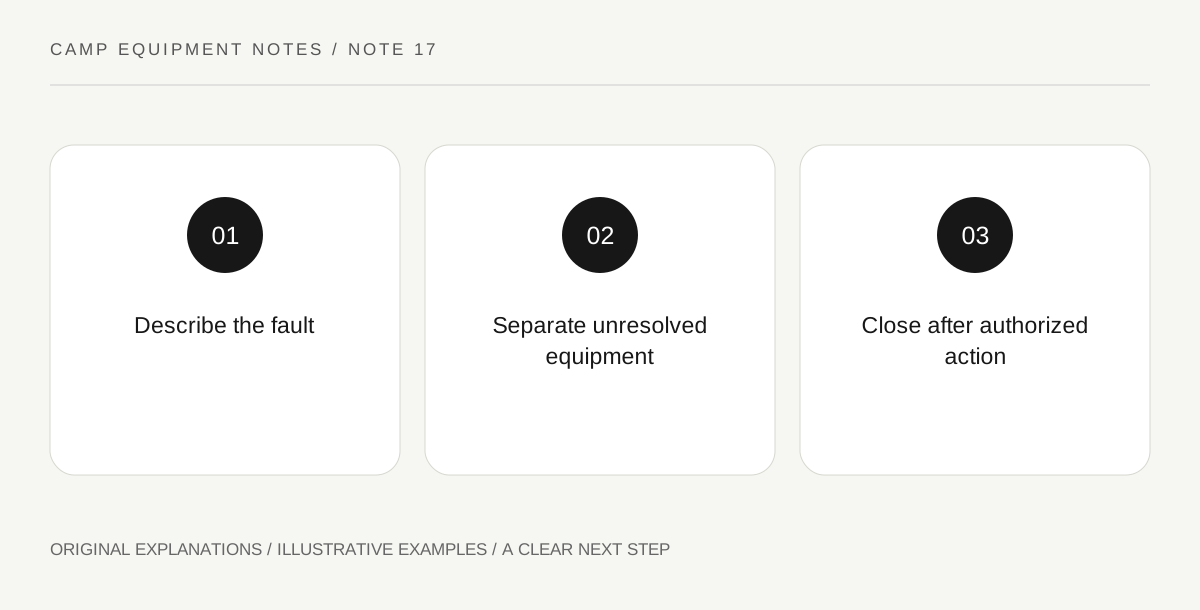
Original explanatory diagram. Read the full method and limitations below.
Describe an observation precisely
Write what happened, where and under which ordinary use conditions. A closure opened behind its slider is more useful than tent annoying. Include the model, date and photographs if they help explain the issue. Avoid guessing at an internal cause or claiming a product defect without evidence. A clear observation makes it easier for a manufacturer or repair service to identify what information is needed and whether the item should remain out of use.
Separate status from repair instructions
Use plain states such as awaiting assessment, approved repair pending or cleared after service. Do not write fixed because a temporary workaround seemed to hold once. Equipment related to shelter, heat, electricity or other safety needs must follow the appropriate manufacturer route. Keep a damaged component out of the ready kit while the status remains unresolved. Physical separation matters because a small tag can fall off or be missed during hurried packing.
Record the authorized next step
Attach the support inquiry or service reference and identify who will act on it. If an approved replacement part is required, record the exact part rather than a vague reminder to buy something similar. Keep receipts and warranty details where they can be found without exposing personal information publicly. Do not combine unrelated faults under a single broad tag; each unresolved issue needs a clear ending before the item returns to ordinary use.
Close the record after a meaningful check
After the approved repair or replacement, complete the maker's recommended inspection and any supported function check. Record what was done and what remains unknown. Update the kit inventory so an old damaged spare does not quietly remain beside the replacement. If the item cannot be restored appropriately, use a suitable disposal or recycling route. The useful outcome is trustworthy status, not keeping every piece of equipment indefinitely.
Illustrative worked example
Illustrative scenario: a camper returns with a chair whose locking mechanism no longer engages consistently. They remove it from the ready storage area and tag the observed behavior, model and date. The manufacturer's response determines the next step. A later record describes the authorized replacement rather than calling an improvised strap a repair. The tag prevents another family member from packing the chair simply because its bag looks complete.
Questions that come up
Can tape mean an item is repaired?
Tape may mark a problem, but it does not establish a supported repair. Follow the equipment maker's guidance and keep unresolved items out of the ready load.
Should small cosmetic marks get the same process?
Use judgment and the maker's guidance. The process is most valuable when damage affects operation or its significance is unclear, rather than for every harmless surface scuff.
References and scope
These sources support the factual background. Examples and exercises are original illustrative teaching material. References do not imply endorsement.
- MSR: Tent Care Tips — Pole joints should be fully engaged; grit and careless handling can damage zippers.
- Cascade Designs: Keeping an MSR Tent Clean and Dry — Model-specific tent cleaning and thorough drying; not a universal cleaner recipe.