Review a camping kit through actions that went wrong
A useful equipment review begins with interrupted actions rather than a shopping list. Recall where the routine became difficult, then identify the smallest supported change that addresses it. Separate comfort preferences from damage, safety questions and conditions that made the whole trip unsuitable.
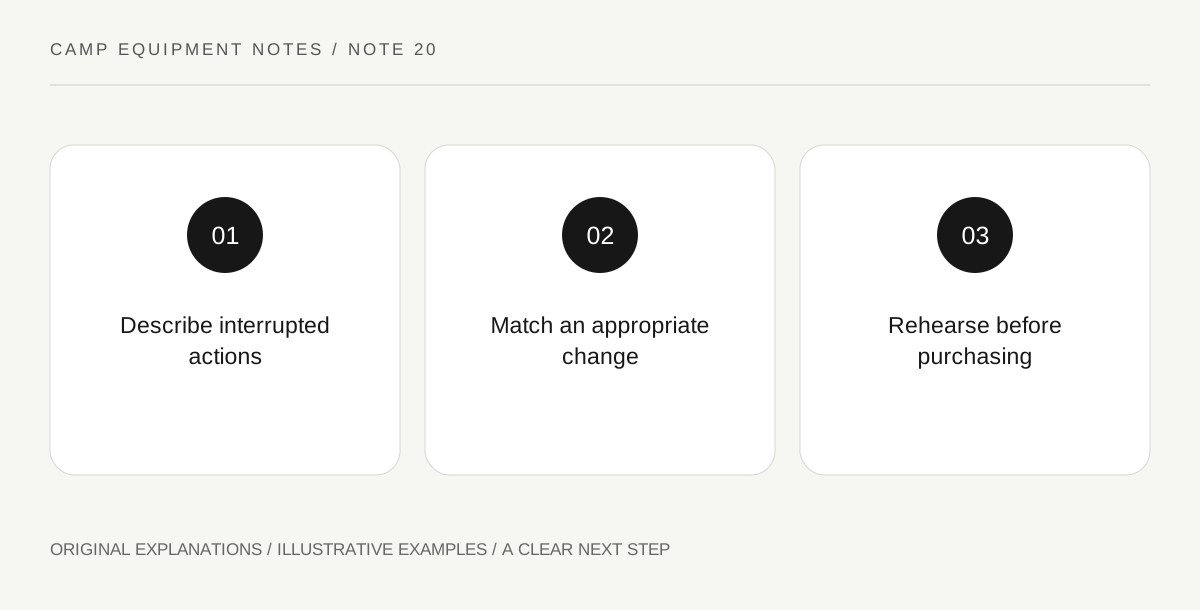
Original explanatory diagram. Read the full method and limitations below.
Record a concrete moment
Write an event with enough detail to explain it: the clean plates were buried under the shelter bag, or a wet towel had no separate return container. Avoid broad verdicts such as the equipment was terrible. Include the setting, who needed what and what happened next. This keeps the review connected to an observable problem rather than the excitement of new products seen online after the trip.
Sort the type of interruption
Ask whether the issue came from access, fit, unclear ownership, incomplete instructions, damage or the trip conditions. These categories point toward different actions. A damaged component requires the maker's assessment; a buried object may need repacking. An uncomfortable personal item may need a fit trial. Do not treat unsuitable weather or a closed facility as proof that one more accessory would have made the original plan appropriate.
Try one change under ordinary conditions
Rehearse the problem at home where doing so is safe and within the equipment instructions. Move the bin contents, try the chair with the actual table or practice the supported tent assembly. Record what changed and whether the interrupted action now works more smoothly. Avoid destructive tests or attempts to prove equipment can exceed its limits. The review is intended to make ordinary use more dependable, not to create a homemade certification.
Give purchases a specific job
If replacement is needed, write a requirement that follows from the observed issue. Needs to fit the packed sleep kit in the available space is more useful than needs to be premium. Include care, storage and transport in the decision. Keep optional aesthetic preferences visible without dressing them as necessities. Finish unresolved repairs and drying work before marking the kit ready; a convincing future shopping plan does not complete the current maintenance.
Illustrative worked example
Illustrative scenario: a group wants a larger storage bin after a frustrating weekend. Reviewing the events shows that the original bin had enough capacity, but the first-needed items were inaccessible and a lid blocked the table. They rehearse a different packing order and location. Only a worn protective sleeve still needs replacement. The review reduces the purchase list by connecting each proposed item to an actual interrupted action.
Questions that come up
Should unused equipment always be removed?
Distinguish optional extras from necessary contingency and safety items. One uneventful trip does not show that equipment intended for less favorable conditions is unnecessary.
How many changes should I test together?
Start with a manageable change whose effect you can observe. Replacing several interacting items at once makes it harder to understand what improved the routine or introduced a new difficulty.
References and scope
These sources support the factual background. Examples and exercises are original illustrative teaching material. References do not imply endorsement.
- NPS: Finding and Setting Up a Campsite — Designated campsite selection, local requirements and environmental hazards.
- MSR: Tent Care Tips — Pole joints should be fully engaged; grit and careless handling can damage zippers.
- Cascade Designs: Keeping an MSR Tent Clean and Dry — Model-specific tent cleaning and thorough drying; not a universal cleaner recipe.