Decide whether a sleeping bag needs spot care or a full wash
Washing an insulated sleeping bag is a care task with several dependencies, not an ordinary load of laundry. Start by identifying the affected area, fill and current manufacturer guidance. The useful decision includes drying capacity as well as the choice of cleaning product.
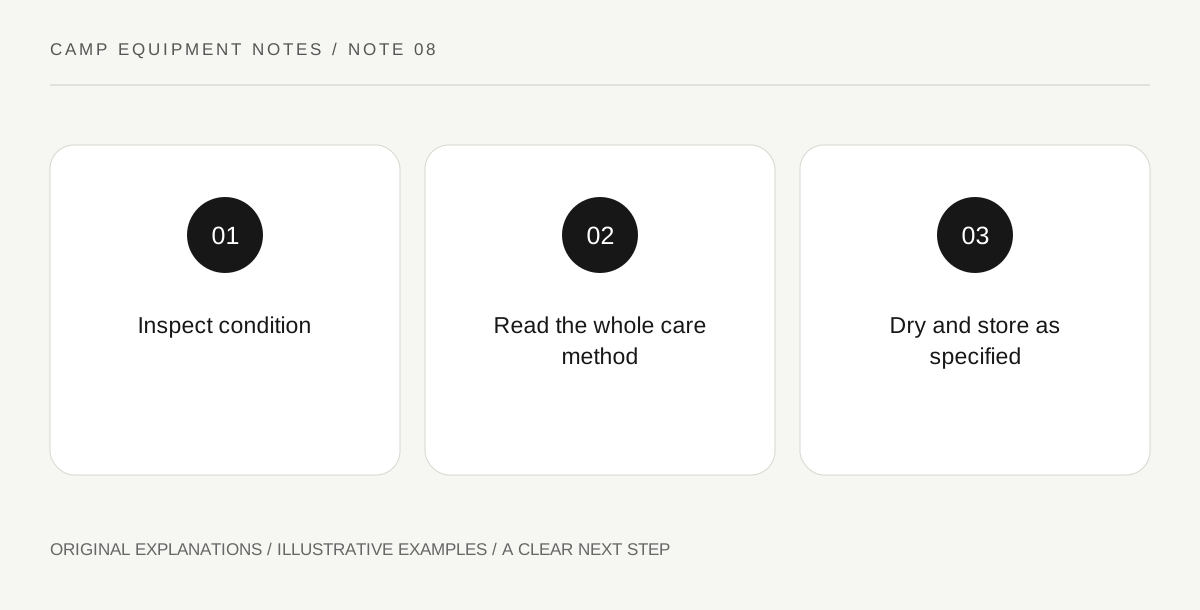
Original explanatory diagram. Read the full method and limitations below.
Inspect the actual problem
Open the bag fully in a clean place and inspect the lining, collar, foot area and outer shell. Distinguish a small visible mark from widespread dirt or an odor whose source is unclear. Check for damage that should be addressed before washing. Record the bag model and fill type; a general camping tip cannot establish the correct method for every shell coating or insulation. Avoid diagnosing lost warmth from appearance alone.
Read the complete care sequence
Find the maker's instructions for cleaning and drying this specific product. Therm-a-Rest discusses spot cleaning small affected areas before committing to a full wash. Treat that as a product-care example, not a universal instruction to scrub any stain. Confirm permitted cleaning agents, machinery and handling. Read through to the end before starting: a suitable washing step can still fail as a plan if the available dryer or drying space is incompatible.
Plan the wet handling
A wet insulated bag is bulky and inconvenient. Think through how it will move between the permitted washing and drying stages without dragging across a dirty floor or being pulled by a small attachment. Check that you can carry out the manufacturer's process calmly. If the needed equipment is unavailable, ask about an approved professional service rather than substituting a convenient aggressive cycle. Convenience should not silently become a change to the care method.
Confirm dryness before storage
Complete the recommended drying process and inspect areas where insulation can remain clumped or moisture can hide. Do not equate a dry outer shell with a fully ready bag. Once ready, use the maker's long-term storage approach instead of leaving the insulation tightly compressed. Keep the wash date and any unresolved concern with the equipment record so the next care decision has a useful history rather than a guess.
Illustrative worked example
Illustrative scenario: a camper sees a small dirty patch near the collar of a named synthetic bag. They locate the current model guidance and learn what localized care is allowed. Before proceeding, they check the drying requirements and available space. The record lists the affected patch, the supported method and the result after complete drying. It does not claim that washing restored a temperature rating or improved performance by a measured amount.
Questions that come up
Can I use the same detergent as my clothes?
Only if the maker permits it. Insulation and shell treatments may require particular care products, so ordinary laundry habits do not establish compatibility.
Should I wash after every short trip?
Use condition and manufacturer guidance. Unnecessary washing can add handling and care risks; drying and appropriate storage remain separate tasks even when a wash is not needed.
References and scope
These sources support the factual background. Examples and exercises are original illustrative teaching material. References do not imply endorsement.
- Therm-a-Rest: Sleeping Bag Care — Follow fill-specific cleaning advice and store dry bags without prolonged compression.